Top

By clicking “Accept All”, you agree to the storing of cookies on your device to enhance site navigation, analyze site usage, and assist in our marketing efforts. View our Privacy Policy for more information.

RADR®, or Response Algorithm for Drug Positioning & Rescue, is Lantern’s proprietary integrated data analytics, experimental biology, biotechnology, and machine-learning-based platform. RADR® is used primarily to predict the potential response patients will have to Lantern’s drugs and to other drugs that are being reviewed and analyzed by Lantern.

RADR® is also being used to help define and develop combination strategies among drugs in development and those that are approved for a range of oncology indications. RADR® uses transcriptome data, genomic data and drug sensitivity data from a wide range of curated sources that are continually being analyzed, monitored and updated. Our RADR® platform is core to our drug development approach for identifying the desired project candidates to in-license and develop.

Our RADR® platform is enabled through access to, and analysis of, a number of key datasets: (i) publicly available databases, (ii) data from commercial clinical studies and trials, and (iii) our proprietary data generated from ex vivo 3D tumor models specific to drug-tumor interactions. We incorporate automated supervised machine learning strategies along with big data analytics, statistics and systems biology to facilitate identification of new correlations of genetic biomarkers with drug activity.

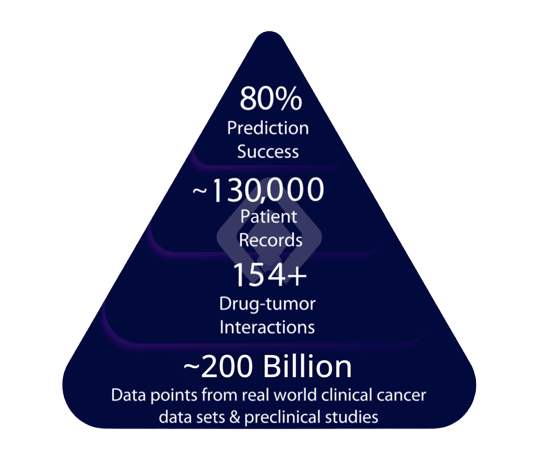
The value of the platform architecture is derived from its validation through the analysis of over
200+ billion oncology-specific clinical and preclinical data points, more than 200+ advanced ML algorithms, and over 130,000+ patient records from 8,163+ datasets.

RADR® has now exceeded 200 billion data points, facilitating increased drug and cancer type-specific biomarker identification, the discovery of new indications, and the identification of additional drug candidates to build out our product pipeline towards advances in cancer therapy.

How It Works

Our artificial intelligence-based machine learning approach combines six automated modules that work sequentially to derive drug and tumor-specific complex biomarker panels. These six modules include: Data Ingest, Data Processing and Curation, Feature Selection, Prediction, Hypothesis Generation, Validation & Feedback, and Patient Stratification & Clinical Trial Design.

RADR® Workflow

Workflow Details

1. Data Ingest

Multi-omics data is received from large, public oncology data sources and private partner data sources. Lantern’s proprietary data is included here as well.

2. Data Preprocessing

This step includes data cleaning, transformation, normalization, and integration without compromising the original quality of data – datasets are reviewed by internal KOLs to ascertain relevance and quality. Data is standardized across patient samples, and connections are made that link preclinical models to patient samples and clinical data.

3. Feature Selection

RADR-A.I. performs proprietary gene filtering via biological, statistical and machine learning-based methods to extract relevant and significant biomarker and genomic features. Findings are benchmarked against published literature and data.

4. Prediction

An automated artificial intelligence algorithm uses filtered gene sets to build, tune and test the algorithm in an iterative process that selects an optimal model having high testing accuracy. This module will also generate 50-200 drug tumor-specific candidate biomarkers.

5. Hypothesis Generation, Validation, and Feedback

Data mining and Machine Learning pipelines lead to hypothesis generation, which guides additional preclinical research in the lab, which produces more data. This data can be used to validate hypotheses, which are then added back to the system, thus improving the accuracy of our predictions.

6. Patient Stratification and Clinical Trial Design

Our final, tuned model uses available patient data on candidate biomarkers to predict medical drug response and stratifies patients as responders, partial responders, or non-responders. Response prediction informs both companion diagnostic (CDx) development and clinical trial design for advancements in experimental medicine.

1. Data Ingest

Multi-omics data is received from large, public oncology data sources and private partner data sources. Lantern’s proprietary data is included here as well.

2. Data Processing & Curation

This step includes data cleaning, transformation, normalization, and integration without compromising the original quality of data – datasets are reviewed by internal KOLs to ascertain relevance and quality. Data is standardized across patient samples, and connections are made that link preclinical models to patient samples and clinical data.

3. Feature Selection

RADR® -A.I. performs proprietary gene filtering via biological, statistical and machine learning-based methods to extract biologically relevant and statistically significant biomarkers and genomic features. Findings are benchmarked against published literature and data.

4. Prediction

An automated artificial intelligence algorithm uses filtered gene sets to build, tune and test the algorithm in an iterative process that selects an optimal model having highest testing accuracy. This module will also generate 50-200 drug tumor-specific candidate biomarkers.

5. Hypothesis Generation, Validation, and Feedback

Data mining and Machine Learning pipelines lead to hypothesis generation, which guides additional preclinical research in the lab, which produces more data. This data can be used to validate hypotheses, which are then added back to the system, thus improving the accuracy of our predictions.

6. Patient Stratification and Clinical Trial Design

Our final, tuned model uses available patient data on candidate biomarkers to predict medical drug response and stratifies patients as responders, partial responders, or non-responders. Response prediction informs both companion diagnostic (CDx) development and clinical trial design for advancements in experimental medicine.

X
Thank you! Here's your Whitepaper
Oops! Something went wrong while submitting the form.

Learn how we are advancing oncology drug development

Download Our Whitepaper
"We are in the golden age of A.I. where we are able to significantly impact the speed and precision at which we develop new drugs."
Panna Sharma
PRESIDENT & CEO, LANTERN PHARMA

RADR®, or Response Algorithm for Drug Positioning & Rescue, is Lantern’s proprietary integrateddata analytics, experimental biology, biotechnology, and machine-learning-based platform. RADR® uses transcriptome data, genomic data and drug sensitivity data from a wide range of curated sources that are continually being analyzed, monitored and updated. Our RADR® platform is core to our drug development approach for identifying the desired project candidates to in-license and develop.

The value of the platform architecture is derived from its validation through the analysis of over 200+ billion oncology-specific clinical and preclinical data points, more than 200+ advanced ML algorithms, and over 130,000+ patient records from 10K+ datasets.

RADR® has now surpassed 200+ billion data points, facilitating increased drug and cancer type-specific biomarker identification, the discovery of new indications, and the identification of additional drug candidates to build out our product pipeline towards advances in cancer therapy.

RADR® Framework

RADR® unfolds across three pivotal categories, each playing a vital role in reshaping the landscape of oncology drug discovery. From extensive data compilation in the Data Ingest to advanced analytical capabilities within Unique Algorithms, and the versatile application of 8 Modules, RADR embodies a comprehensive and informed approach to advancing cancer therapy.

1
Oncology focused real-world data from multiple data sources and data types
2
More than 200+ unique advanced algorithms
3
8 AI-Powered Modules for Oncology Drug Discovery and Development
1

Data Sources and Types

At the core of RADR® lies an unparalleled wealth of information. The data Ingest category signifies the extensive compilation of data derived from real-world patient and clinical data, along with preclinical studies. Drawing from diverse sources and data types, this expansive dataset forms the foundation for informed and data-driven decisions in the pursuit of advancements in cancer therapy.

Clinical Trials

In vitro/ In vivo Studies

Genetic Screens/Panels

Chemical Structure

Collaborator Studies

Multi-Omics

Drug Response

Public / Private Repositories

2

200+ Algorithms

RADR®'s Unique Algorithms category showcases the platform's advanced analytical capabilities. Operating with a diverse set of 200+ AI algorithms, including the distinctive Ensemble approach algorithm developed by Lantern, RADR® brings sophistication to data analysis. This diverse algorithmic toolkit facilitates a nuanced understanding of complex patterns in oncology, enabling a more comprehensive exploration of the intricacies within the field.

Tree
Based

Apirio
ANFIS
DENFIS
FH.GBML
M5Rules
OneR
PART
Prim
RFRules
SBC

Deep
Learning

LASSO
Ridge
ElastiNet
GAM
KNN
SVM
SVR
LDA
QDA

Bayesian
Based

KMeans
T-SNE
UMAP
PCA
PLS
PLS-DA
Hierarchical
Pathway-based
Weighted KMeans
Gaussian-mixed Models

Rule
Based

Decision Tree
BstTree
C5.0
Ctree
Cubist
Evtree
M5
Rotation Forest
Rpart2
RpartCost

Clustering

Naive Bayes
Gaussian NB
BartMachine
Blasso
Bridge
BRNN
NB Discrete
Spikeslab
Tan
VbmpRadial

Others

avNNET
BRNN
DNN
ELM
MLP
Multinom
MXNET
NNET
pcaNNET
RBF
CaretEnsemble
GBM
Light GBM
XGBoost
ORF
AdaBoost
BagEarth
RandomForest
TreeBag
LogitBoost
Apirio
ANFIS
DENFIS
FH.GBML
M5Rules
OneR
PART
Prim
RFRules
SBC
LASSO
Ridge
ElastiNet
GAM
KNN
SVM
SVR
LDA
QDA
KMeans
T-SNE
UMAP
PCA
PLS
PLS-DA
Hierarchical
Pathway-based
Weighted KMeans
Gaussian-mixed Models
Decision Tree
BstTree
C5.0
Ctree
Cubist
Evtree
M5
Rotation Forest
Rpart2
RpartCost
Naive Bayes
Gaussian NB
BartMachine
Blasso
Bridge
BRNN
NB Discrete
Spikeslab
Tan
VbmpRadial
avNNET
BRNN
DNN
ELM
MLP
Multinom
MXNET
NNET
pcaNNET
RBF
CaretEnsemble
GBM
Light GBM
XGBoost
ORF
AdaBoost
BagEarth
RandomForest
TreeBag
LogitBoost
Apirio
ANFIS
DENFIS
FH.GBML
M5Rules
OneR
PART
Prim
RFRules
SBC
LASSO
Ridge
ElastiNet
GAM
KNN
SVM
SVR
LDA
QDA
KMeans
T-SNE
UMAP
PCA
PLS
PLS-DA
Hierarchical
Pathway-based
Weighted KMeans
Gaussian-mixed Models
Decision Tree
BstTree
C5.0
Ctree
Cubist
Evtree
M5
Rotation Forest
Rpart2
RpartCost
Naive Bayes
Gaussian NB
BartMachine
Blasso
Bridge
BRNN
NB Discrete
Spikeslab
Tan
VbmpRadial
avNNET
BRNN
DNN
ELM
MLP
Multinom
MXNET
NNET
pcaNNET
RBF
CaretEnsemble
GBM
Light GBM
XGBoost
ORF
AdaBoost
BagEarth
RandomForest
TreeBag
LogitBoost
3

AI-Powered Modules

RADR® introduces a modular approach tailored for the complexities of oncology drug discovery. These modules are optimized to address various aspects of the process, ranging from deciphering the mechanism of action for any molecule to optimizing drug combinations. The modular design ensures a strategic exploration of multiple areas within oncology, promoting an informed and innovative approach to advancing cancer therapy.

Mechanism of Action Discovery
Identifies how a drug interacts with biological pathways by analyzing multi-omic data, molecular features, and response patterns. This helps uncover previously unknown mechanisms that can guide indication selection and combination strategies.
Indication Prioritization
Analyzes genomic and clinical data to identify the cancer types or subtypes most likely to respond to a therapy. This enables more focused development programs and higher-probability clinical strategies.
Drug Combination Optimization
Predicts synergistic drug combinations using machine learning models trained on large-scale response and pathway datasets. These insights help design combination therapies that improve efficacy and overcome resistance.
Biomarker Signature Generation
Discovers molecular biomarkers that predict patient response or resistance to a therapy. These signatures support precision trial design, patient stratification, and regulatory strategy.
Molecular Property Characterization
Evaluates specialized molecular attributes, such as pharmacologic and physicochemical properties, using AI-driven modeling. This helps assess drug-like characteristics and optimize candidates for clinical success.
ADC Design and Optimization
Applies AI models to optimize key parameters in antibody-drug conjugates, including payload selection, linker stability, and target interactions. This accelerates the design of more effective and selective ADC therapies.
Checkpoint Inhibitor Combination Discovery
Identifies drug combinations that boost immune checkpoint inhibitor efficacy by modeling immune and tumor responses to improve immunotherapy outcomes.
Binding Interaction Analysis
Predicts potential binding sites and molecular interactions between drugs and their biological targets. These insights support rational drug design, mechanism validation, and lead optimization.

Lantern labs - A Growing Suite of AI Modules

RADR® powers a new generation of specialized AI modules designed to solve high-impact problems in oncology drug development.

PredictBBB™
blood-brain barrier permeability prediction
Visit now
withZeta™
AI co-scientist for rare cancer research
Visit now
Lantern Labs
The experimental engine inside Lantern Pharma
Visit now
Looking to integrate advanced AI into your research?
Let’s explore what’s possible together.
Connect with us!
Contact us